Research-use survival prediction tool

Blood-Based Clinico-Genomic Survival Nomogram

Tool developed for survival prediction in Treatment Naive Metastatic Castration-Resistant Prostate Cancer (mCRPC)

Background:

We developed an integrated clinico-genomic prognostic nomogram combining clinical prognostic factors with copy number alteration (CNA)-based risk scores in circulating tumor DNA (ctDNA). The CNA-based risk score, referred to here as the composite genomic prognostic score (CGPS), is calculated using a patented, liquid biopsy-derived gene CNA signature that stratifies patients into low- and high-risk groups.

This tool provides individualized survival probability estimates at 24 and 36 months.
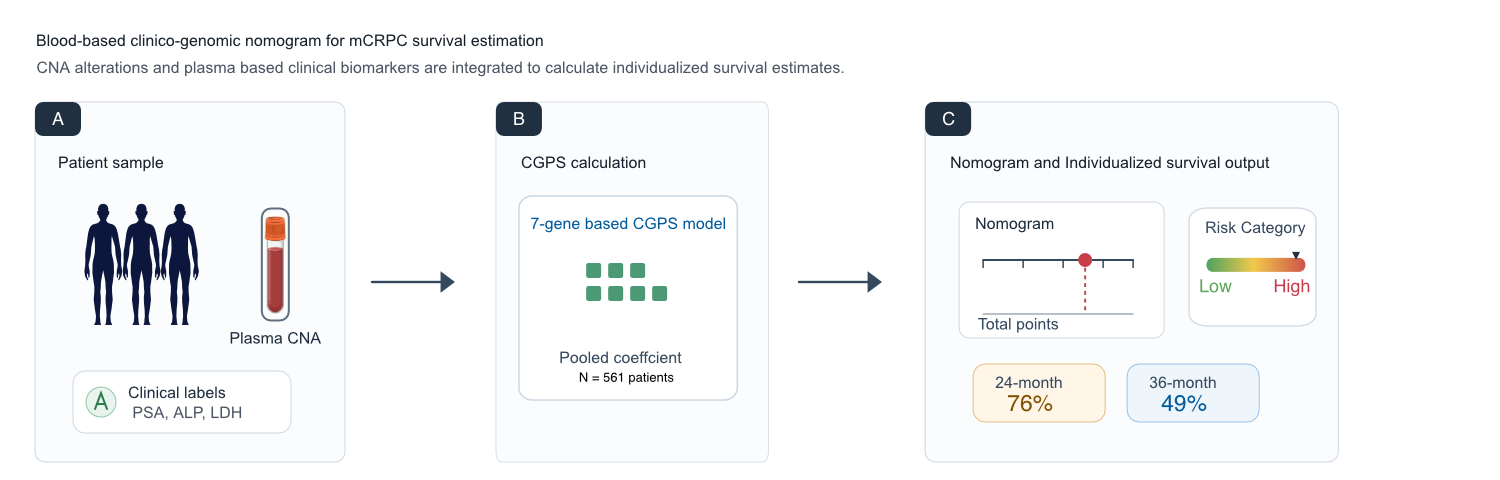
Schematic figure showing 7-gene CGPS inputs, PSA, ALP and LDH clinical factors, Cox nomogram scoring, risk group, and 24- and 36-month survival output.

Figure. Generation of individualized survival estimates from blood-based clinico-genomic profiling in mCRPC. Circulating tumor DNA copy-number alteration (CNA) calls are combined with plasma clinical biomarkers into a composite genomic prognostic score (CGPS), which is mapped through a nomogram to patient-specific 24- and 36-month survival probabilities and risk category. CNA , copy number alteration; CGPS , composite genomic prognostic score; mCRPC , metastatic castration-resistant prostate cancer.

Open calculator

Instructions:

Enter available patient parameters. If a parameter is not available, uncheck the box.

  1. Step 1: Laboratory measurements should be obtained at progression to the castration-resistant state.
  2. Step 2: If genomic results are available:
    Enter an existing LOW/HIGH CGPS classification, or select the detected gene gains and losses so the app can calculate it.
  3. Step 3: Click 'Calculate' to generate survival predictions.

Explore the survival result.

Clinical Prediction Workflow

Step 1: Enter clinical values
Step 2: Enter 7-gene CGPS

Choose how to provide the CGPS information:

Select this option if the patient has either an existing LOW/HIGH CGPS classification or copy-number results for the seven genes.
Step 3: Review Nomogram Survival Estimates
Advanced: Nomogram Details (click to expand)
Calculation details
Active mode:
CGPS: composite genomics prognostic score
Pre-computed Risk Score:
Computed Individual Risk Score:
Threshold:
Resulting Risk Group:
Export Prediction Report

Non-Commercial Terms of Use | Disclaimer | Feedback

References

  1. Huang J, Du M, Soupir A, Wang L, Tan W, Kalari KR, Kilari D, Park J, Huang CC, Kohli M, Wang L. Plasma Copy Number Alteration-Based Prognostic and Predictive Multi-Gene Risk Score in Metastatic Castration-Resistant Prostate Cancer. Cancers (Basel). 2022;14(19):4714. https://doi.org/10.3390/cancers14194714
  2. Fadlullah MZH, Nix D, Herberts C, Maurice-Dror C, Wyatt AW, Schmidt B, Fairbourn B, Tan AC, Wang L, Kohli M. Multi-gene risk score for prediction of clinical outcomes in treatment-naïve metastatic castrate-resistant prostate cancer. JNCI Cancer Spectrum. 2025;9(2):pkaf025. https://doi.org/10.1093/jncics/pkaf025
  3. Kohli M, Shankar A, Lloyd J, Wang L, Huo X, Fadlullah MZH, Tan AC, Finkelstein J. Clinico-Genomic Nomograms for Estimation of Survival Risk in Metastatic Castrate-Resistant Prostate Cancer. JNCI Cancer Spectrum. 2026;10(3):pkag042. https://doi.org/10.1093/jncics/pkag042
  4. Kohli M, Wang L, Tan AC, Fadlullah MZH, Shankar A, Mandrekar SJ, Haaland B. Clinico-genomic risk stratification for biomarker-enriched trial design in poor-prognosis metastatic castrate-resistant prostate cancer (mCRPC). The Journal of Liquid Biopsy. 2026;13:100486. https://doi.org/10.1016/j.jlb.2026.100486